Under the hood
Gapless, two different ways.
How: every MP3 carries a few milliseconds of silence at each end. The player cuts exactly that and joins the tracks. Chrome can cut to the sample. Safari can only cut in 26-millisecond blocks, which leaves a gap you can hear. So on Safari and iPhone the page decodes the audio itself, cuts it at the exact sample, and hands Safari lossless audio to play.
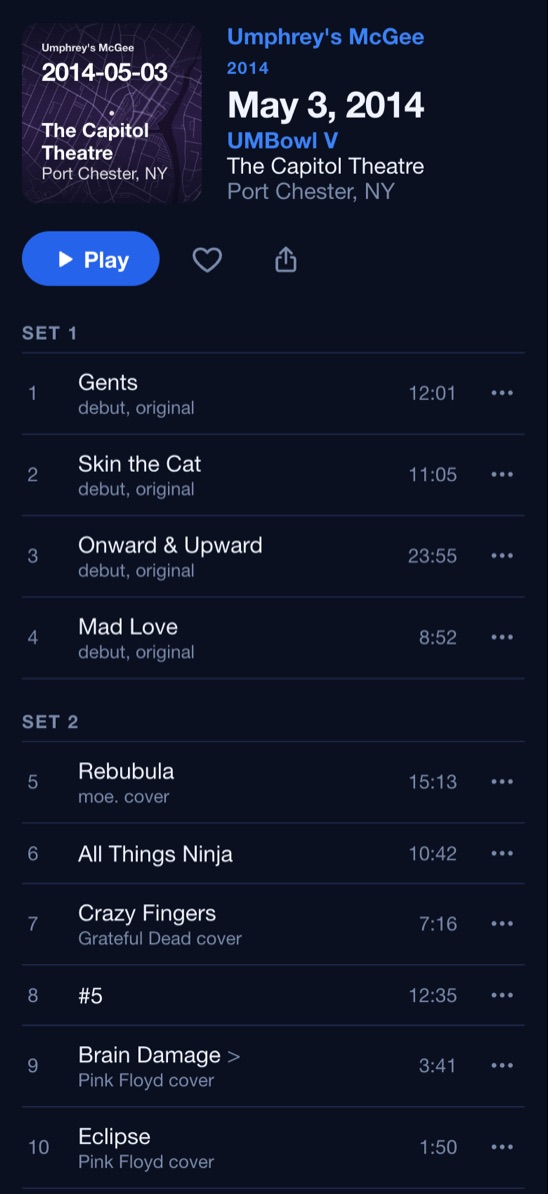
Why: segues are the point of these bands. I listened to all 14 joins in one continuous set from 2014. Every one was clean.
It keeps playing when the phone locks.
How: the usual web trick for gapless audio stops when an iPhone locks, so it was ruled out. Everything plays through one ordinary audio player that iOS keeps alive, and that player never reloads when you change pages. The lock screen shows the song, the show, and the cover.
Why: a three-hour show gets heard with the phone in a pocket.
Two fan projects, matched track by track.
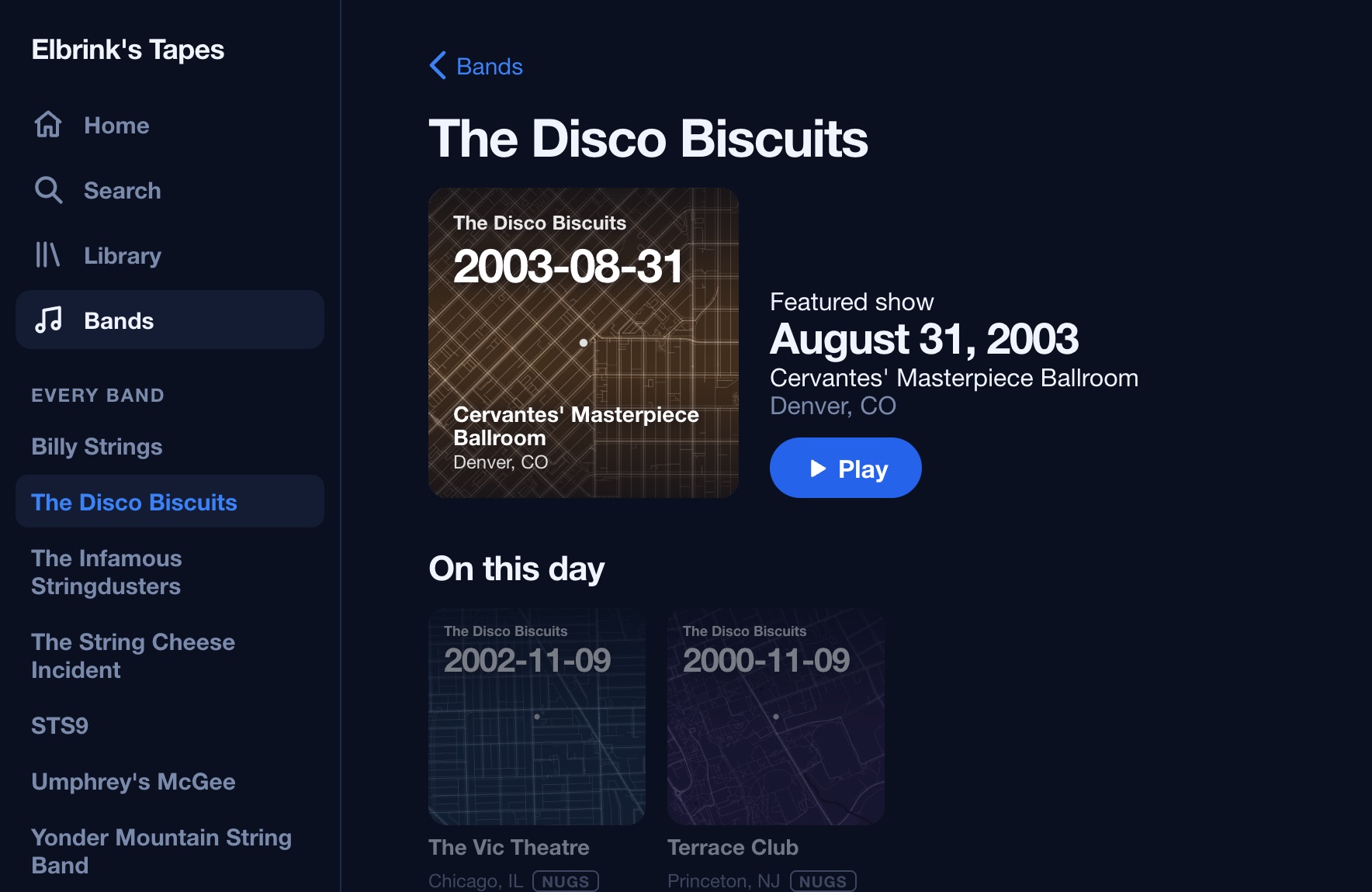
How: Umphrey's setlists come from All Things Umphrey's, the fan-run database of every show. Audio comes from the archive. A matcher attaches each taped track to the right song in six passes, including jams that grew out of a song and tapes with no titles at all.
Why: the two complete each other. The tapes hold the sound. The database holds every show, 2,999 of them, with sets, encores, and guests. Fewer than 3 in 100 tracks are left unmatched, and ten spot-checked shows match their real setlists.
Setlists from the tapers themselves.
How: setlists come from the tapers themselves for every band without its own database. Each band's song list was checked by hand against press setlists and the band's own releases. String Cheese's list holds 584 songs, 79 of them covers.
Why: the tapers already wrote the history down. Many rolled tape on the whole night, opening acts and set-break music included. Tapes plays the band's sets and leaves the rest on the archive, where the full recording lives.
Every room in one place.
How: tapers write a venue the way fans say it, so one room can go by several names across thirty years of shows. Each name now points to one real venue, shared by every band that played there.
Why: a venue page should hold every night in that room. Two rooms with the same name in different cities each get their own shows, and every map cover lands on the right street.
Each band's rules, in its own settings.
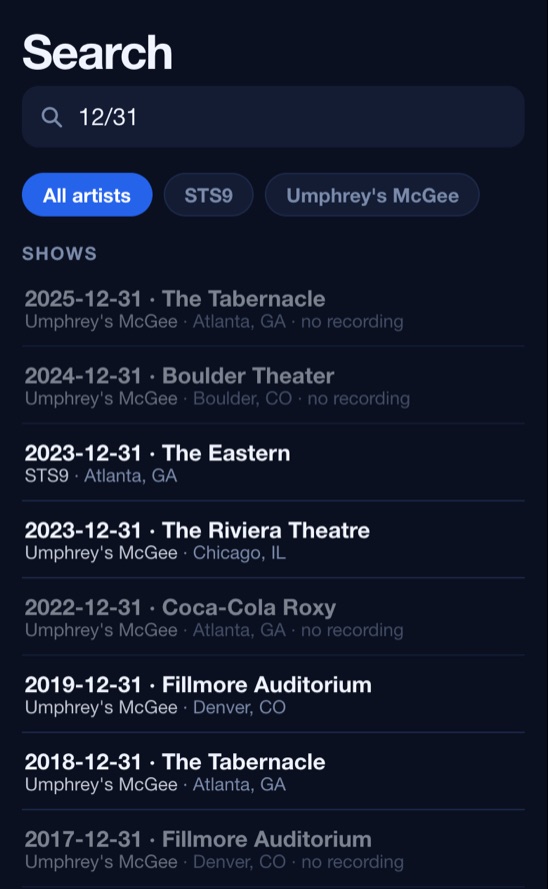
How: Umphrey's sells its official soundboard recordings. Any copy of one on the archive never plays, and the show falls back to its next best recording. STS9 asked for audience tapes only, so its soundboards, matrixes and Live PA sets never play. String Cheese sells its own soundboards too, so only its audience tapes play. On any band, a tape whose source can't be confirmed stays off until someone checks it. A show known only from a held-back tape still shows its setlist and says why there's no player. One Umphrey's show the band put on the archive itself, for the NIU February 14th Memorial Fund, stays playable and says why.
Why: each band sets its own terms. Rules in each band's settings, not in the code, means every new band brings its own.
Polite to the people who host the music.
How: audio streams straight from the archive. Nothing is copied, nothing is rehosted, and there are no downloads. Every recording links to its page on the archive. The setlist database got one request per year of shows, cached and never asked again. 46 requests, total, ever.
Why: both are run by volunteers and a nonprofit. This app exists because of them.
Playback that keeps going.
How: the archive keeps more than one copy of every recording, on more than one server. The player retries, restarts downloads that freeze, and when one server is busy, asks the archive where else the recording lives and switches.
Why: the archive serves a huge library for free. A little care on this end means a three-hour show plays start to finish.
A bug found by listening.
How: on iPhone, songs sometimes stopped halfway with no error. When the phone's buffer was full, the player sent two pieces of audio at once and Safari dropped one, leaving a five-second hole. Now pieces go in one at a time and none is ever thrown away.
Why: a song that silently stops is the worst kind of bug. Testing by ear on a real phone found it.
Public to read, private to save.
How: the music database only allows reading. Favorites are locked at the database so each listener sees and changes only their own. Both were tested from the outside.
Why: no passwords to leak, and no way to touch someone else's favorites.